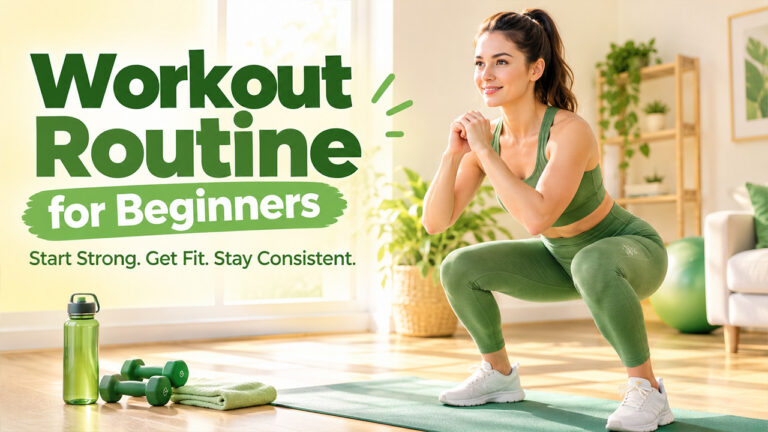
Starting your fitness journey doesn’t have to involve expensive gym memberships or special gears – all you really need is some space where you can work out at home and commit to doing a few sessions per week. It’s important to start slow when working on a fitness program, so here’s a 4-week plan to get you started with manageable moves as we focus on building strength over time.
These five simple yet effective bodyweight exercises will help you develop and strengthen key muscle groups such as the legs & glutes, chest & shoulders, back & core. We’ve kept everything short and repeatable too and included some much-needed rest days in there to make things more balanced overall. This plan works well if you’re a generally healthy adult but completely new to having a more structured approach to exercise.
Why a Structured Home Exercise Routine Matters
Routines make exercising easy by giving you a clear idea of where your workout fits into the week. Without a plan, newcomers may tend to go overboard with their workouts before skipping a few days, repeating certain motions endlessly, and then getting discouraged. Consistency becomes much easier when we have a schedule.
Since bodyweight exercises focus on mastering basic movement patterns like squatting, pushing, bridging, and stabilizing the trunk, you don’t need weights or machines to do them.
Make progress gradually by finishing each exercise fully first. You can increase repetitions or the number of times you do it after some time.
Shorter sessions repeated consistently are better than having an ambitious workout plan that’s hard to stick with.
Remember strength training as just one part of your overall activity routine. The World Health Organization (WHO) recommends that all adults do at least 150 to 300 minutes per week of moderate-intensity aerobic activity (like brisk walking), plus muscle-strengthening activities using major muscle groups on at least two days per week.
The WHO’s physical activity guidance includes details about how much and what types of activity you should aim for. You can also read the CDC’s recommendations for physical activity for adults. People who are beginners might need some time before they’re able to reach the recommended activity levels, which could include things like walking, cycling, dancing, or anything else they enjoy.
Before You Begin: Safety, Warm-Up, and Ground Rules
There are three ground rules that will be applied at each session.
Medical clearance
If you have an existing chronic condition, current injury or have been inactive for a long time, please consult your health care provider. They will be able to let you know if there’s anything specific you need to avoid or modify during your exercise program.
Warm-up (5 minutes)
To start your training sessions, spend five minutes doing some form of prep work that gets you warmed up.
This includes things like marching in place, arm circles, hip circles, and even slow practice squats — aim for about 75 seconds of time spent on each one.
The purpose of this warm-up is to get your heart rate going, raise your body temperature, and rehearse all the different kinds of movements you’re about to do in your workout.
Effort and soreness
Choose a level where the final two reps are difficult, but your technique is maintained.
Mild muscle soreness after workouts (which disappears within ~72hours) is normal – especially during the first two weeks.
However, sharp or increasing pain indicates you need to stop the workout and consult with your health care provider.
The Five Exercises of a Full Body Workout at Home
1. Bodyweight Squat
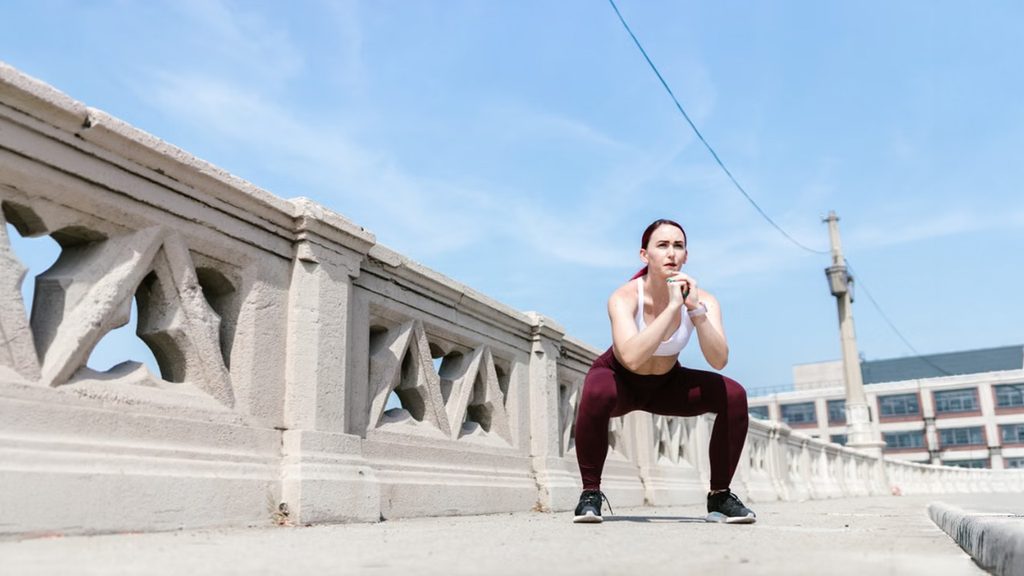
Target muscles: Quadriceps, Glutes & Hamstrings.
How to perform: Stand with the feet shoulder-width apart and the toes turned slightly outward. Push the hips back and bend the knees until the thighs approach parallel to the floor, then press through the heels to stand.
2. Push-Up
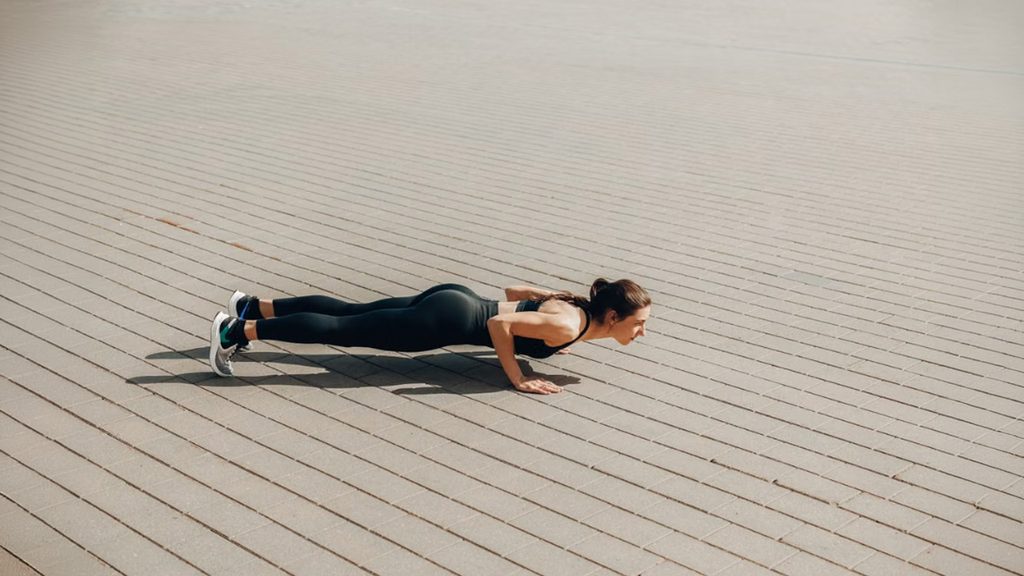
Target muscles: Chest, shoulders, triceps, & abdominal muscles.
How to perform: Place your hands a little wider than your shoulder width and then knees on the floor, forming a line from head to knees. Lower the chest toward the floor by bending the elbows, then press back up.
3. Glute Bridge
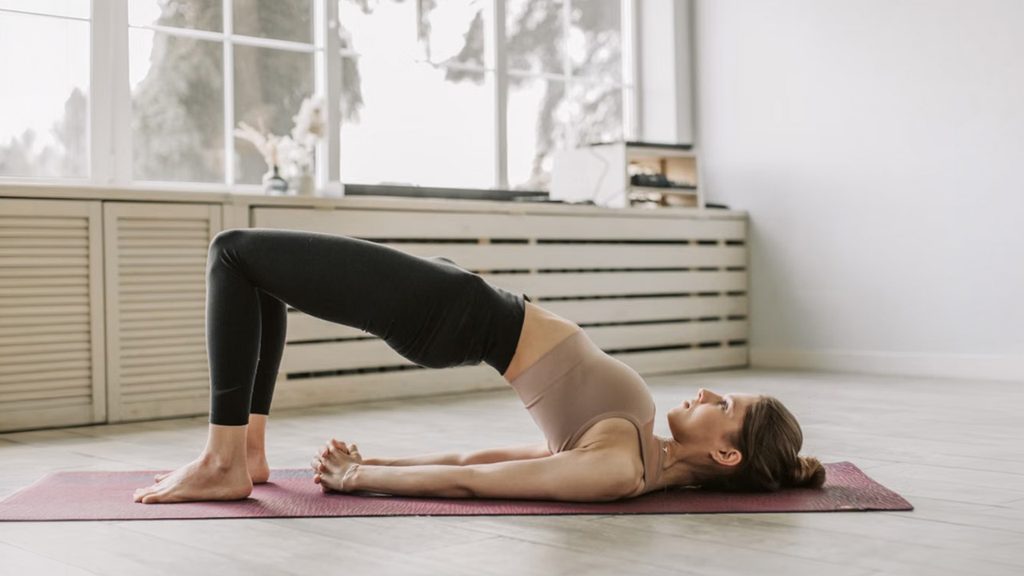
Target muscles: Glutes, hamstrings, lower back.
How to perform: Lie on your back with the knees bent and the feet flat, hip-width apart. Press through the heels to lift the hips until the body forms a straight line from shoulders to knees, hold for one second, and lower slowly.
4. Bird Dog
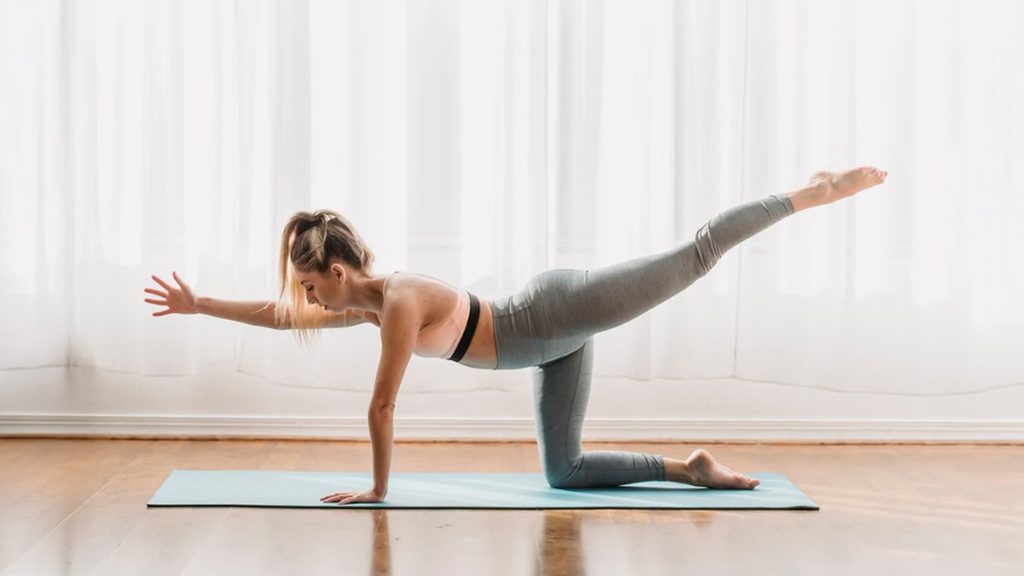
Target muscles: Lower back, glutes, shoulders, & abdominal muscles.
How to perform: Begin on the hands and knees, with the wrists beneath the shoulders and the knees beneath the hips. Extend the right arm forward and the left leg backward at the same time, pause briefly, return, and repeat on the opposite side.
5. Forearm Plank
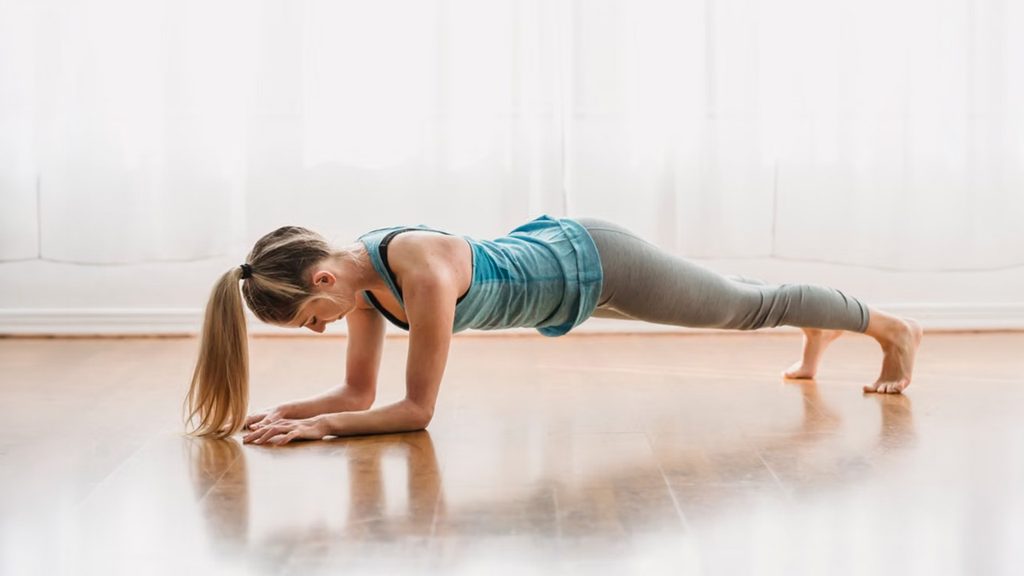
Target muscles: Abdominal muscles, shoulders, & glutes.
How to perform: Rest on the forearms and toes with the elbows just below the shoulders. Hold the body in a straight line from head to heels while breathing.
The 4-Week Home Workout for Beginners Plan
The complete program takes you through four weeks’ worth of progressively more challenging workouts. You’ll need to finish all the sets of an exercise before switching to another one, but if there’s anything about any of these moves you’re unsure about (like how many bird dog reps you do on each side, or how long you can hold a plank), take notes here and just use the easier version you can do with proper form.
In week 1, perform 2 sets of 8 repetitions on each exercise, hold your plank position for 15 seconds, and take 60-second breaks in between. Each workout will last approximately 20 minutes once you factor in the warm-up.
In week 2, increase the reps a bit by performing 2 sets of 10 repetitions on each move, holding your plank position for 20 seconds, taking 60-second breaks in between. This time around, each workout will last around 22 minutes once you include your warm-up. Just increase each set by 2 extra reps without changing the amount of time you spend resting in between. It won’t be much more than what you’ve already gotten used to doing.
Week 3, Add Set! Complete three (3) sets of ten (10) reps for each exercise. Hold your plank for twenty-five (25) seconds and rest forty-five (45) seconds between sets. Each workout will last around twenty-five (25) minutes, including the warm-up. The third set provides an additional fifty percent (50%) increase in total number of sets while shortening the rest time to heighten the cardiovascular demands on this session.
Week 4, Consolidate! You’ll be completing three (3) sets of twelve (12) reps for each exercise. Hold the plank for thirty (30) seconds and rest forty-five (45) seconds between sets. Each workout lasts roughly twenty-eight (28) minutes, including the warm-up. This is your most intense week so far, offering the greatest amount of volume within the entire program. Now you can keep going and increase the reps and sets as needed.
Weekly Schedule: Rest Days and Daily Exercise
Strength sessions have been scheduled on these 3 non-consecutive days to allow sufficient (at least 48 hours) recovery time for the associated muscle groups.
Recovery is when adaptation happens. Rest days play a crucial role in this whole personal training program.
| Day | Activity |
| Monday | Workout session |
| Tuesday | Minimal activity like 20 to 30 minutes of walking |
| Wednesday | Workout session |
| Thursday | Rest or mild stretching |
| Friday | Workout session |
| Saturday | Minimal activity like 20 to 30 minutes of walking |
| Sunday | Complete rest |
The days may be shifted to fit individual calendars if workout sessions are not scheduled on consecutive days.
Tracking Progress and Avoiding Common Mistakes
The most rewarding part about progressing in your training can be seeing how far you’ve come at the end of every workout — this means having some progress markers that are easy for you to keep track of.
After each session, note down how many reps were completed (for example, push-up reps), the length of time spent doing planks, as well as a perceived level of exertion score from 1–10 (where 10 = maximal effort).
Before starting Week 1, and again after completing Week 4, carry out a basic assessment to measure your progress by completing these tasks:
- How many knee push-ups could you complete with good form?
- What’s the longest amount of time you could hold yourself up using just your forearms in a plank position?
- And how many bodyweight squats could you complete within 60 seconds?
The following errors are common among beginners:
- Skip your warm-up – You won’t have properly warmed up cold muscles/joints.
- You’ll prioritize reps over form – This will reduce the efficacy (and increase your chances of getting injured).
- Neglecting your rest days – Rest is important to make gains in your strength.
Conclusion
You don’t need any equipment, a lot of time, or prior experience in order to do home exercises. All you need is a well-defined structure, proper technique, and regular attendance. The four-week plan set out here includes five basic exercises, a gradual progression, and scheduled recovery periods, all of which contribute to building strength and help establish a workout routine that can be kept up. At the end of Week 4, you should compare your results with the first week’s results and select the next step: repeating the program with more variations, adding sets, and/or additional aerobic activity. Consistent practice over several weeks is what produces noticeable improvements.
FAQs :
Can I really get fit without any equipment?
Yes, bodyweight exercises like squats, push-ups, planks, etc. don’t require any equipment.
How many days a week should I work out?
Mostly 3 days a week and then rest days in between.
How long does each workout take?
Each session takes about 20 to 30 minutes.
When will I start seeing results?
Visible changes usually take a lot of time to appear.
What if I can’t finish all the reps?
Do what you can and rest when needed.